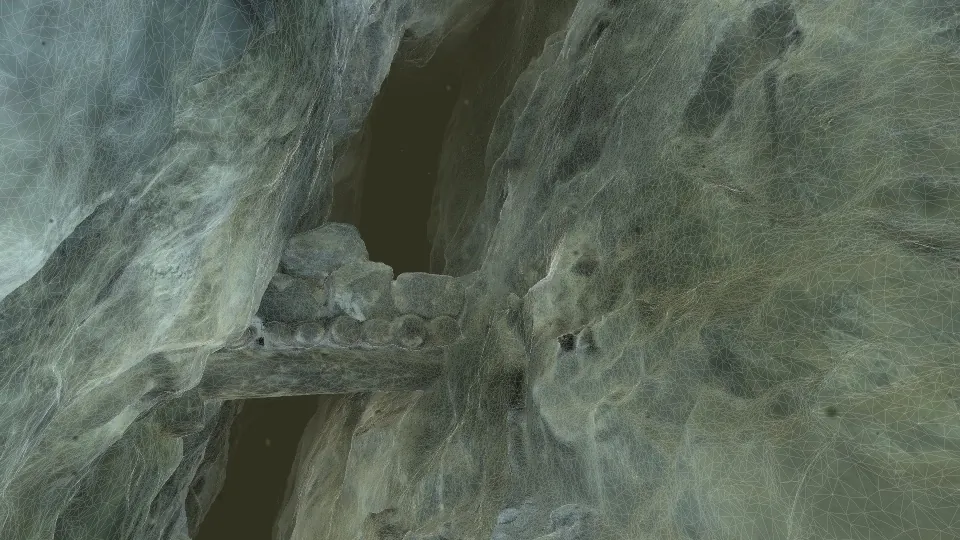
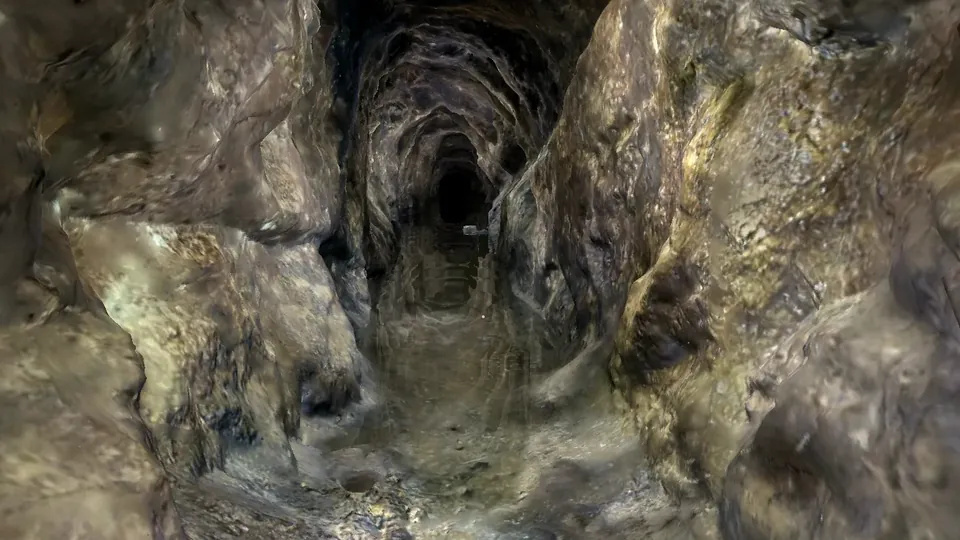
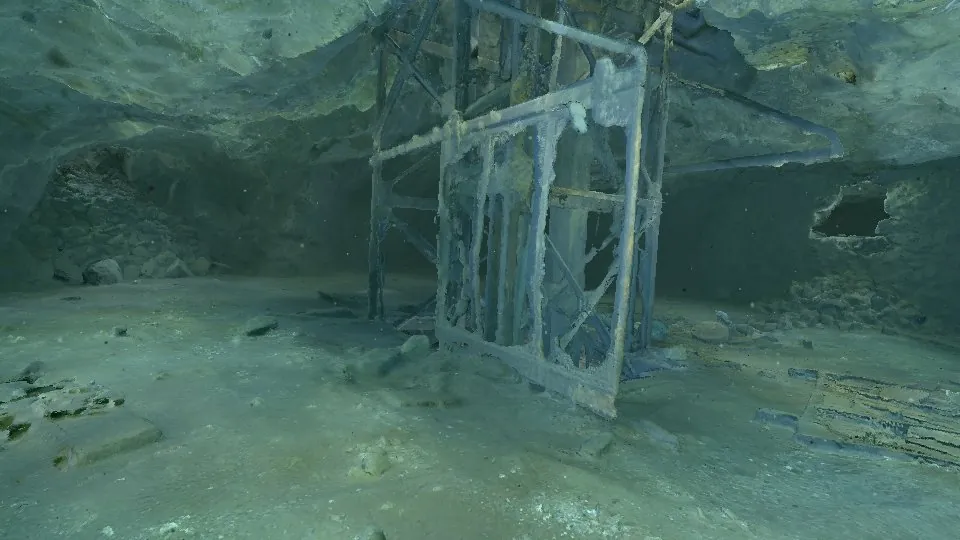
Open a scan here and you are moving through the complete survey: every triangle the photogrammetry produced, at full texture resolution, with nothing thrown away. No download, no software, no workstation. That sounds ordinary until you look at what is actually being delivered.
WHAT IS IN ONE SCAN
The real numbers.
Measured 2026-09-18 with nxsedit.
Scan
Triangles
Points
Published size
Extent
Tapadla Chromite Mine
40.0 M
21.5 M
630 MB
~86 m across
Maria Concordia Magnesite Mine
20.0 M
12.1 M
544 MB
~758 m across
Marie Agnes Mine
18.4 M
10.1 M
412 MB
~336 m across
Extent is the width of the sphere that encloses the whole site. Those published sizes are already compressed; the source photographs and the working models behind them run to hundreds of gigabytes.
FOR COMPARISON
How big is 40 million, really?
A detailed game character100 k
A typical model on a 3D web gallery500 k
What a scan is usually cut down to for the web250 k
Marie Agnes Mine, as published here18.4 M
Tapadla Chromite Mine, as published here40.0 M
A whole video game level is usually built from fewer triangles than one of these scans. The difference is that a game is modelled by hand to be cheap to draw; a scan is measured, and measurement does not simplify itself.
WHY IT IS HARD
Why a normal 3D viewer cannot open this.
It does not fit in memory
Loaded the ordinary way, the bare geometry of Tapadla Chromite Mine needs about 0.91 GB of graphics memory before a single texture is added. A laptop with built-in graphics borrows that from system RAM; a phone has less again. The tab runs out of memory and the page dies.
Everything arrives before anything appears
A normal web 3D file has to download completely before it can be shown. On a home connection, 630 MB is minutes of staring at a blank screen, and one wrong click wastes all of it.
The graphics card cannot draw it all
Even if it fitted, no integrated GPU can push tens of millions of triangles sixty times a second. Most of them are smaller than a pixel on screen: enormous cost, no visible difference.
The textures are the other half
Colour is what makes a scan readable: tool marks, rust, sediment, timber grain. Each scan carries thousands of texture tiles. Sent all at once they stall the page; sent carelessly they cause the stutter people blame on "heavy 3D".
THE USUAL ANSWER
Throw the survey away, or keep it to yourself.
Cut it down
General 3D galleries cap what you can upload and expect models in the hundreds of thousands of triangles. Getting 40.0 million down to that means keeping roughly one triangle in every 160. What survives is the shape of the passage. What goes is everything that made it worth documenting: chisel marks, bolt holes, the edge of a collapse, the grain of a timber support.
Or keep it on a workstation
The alternative is the full model in specialist software: a multi-gigabyte download, a licence, a capable computer and someone who knows the program. That works for the survey team. It does not work for a museum visitor, a funder, a heritage officer, a journalist or a diver's family.
So the record either loses its detail, or it never leaves the hard drive. Most underwater documentation ends up in one of those two places.
WHAT WE DO INSTEAD
Send only what the eye can use.
The scan is rebuilt as a tree of detail levels
Before publishing, the model is turned into thousands of small pieces at several levels of coarseness, each piece compressed on its own.
The browser asks only for what is visible
As the visitor moves, the viewer works out which pieces fall inside the view and how much detail each deserves at its distance, then requests exactly those byte ranges from the server.
Detail arrives while you keep moving
Coarse pieces show immediately and sharpen as finer ones arrive. Textures are decoded away from the main thread and uploaded in small batches, so the picture keeps moving rather than freezing.
What leaves the view is released
Pieces you have passed are dropped from memory before it fills, which is what keeps a 16 GB laptop, and a phone, from running out.
Full detail near the viewer, coarse pieces further away, nothing at all behind.
The result: a scan begins rendering one to two seconds after you open the link, on an ordinary laptop over a normal connection, and sharpens as you explore. Phones get the same scan with a smaller memory budget. For the technical version, with commands and numbers, read how to stream a 3D model with 100 million triangles.
WHY IT MATTERS
What this changes.
The record stays whole
What you publish is the survey, not a souvenir of it. Anyone can go back to the same detail later, including people who will never dive the site.
A link instead of a hard drive
Send an address to a museum, a funder, a supervisor or an audience. It opens on whatever they already have.
Places that will not wait
Mines flood and collapse, wrecks corrode, cave passages silt up. A scan that people can actually open is a record that will still be read when the site has changed.
The dive becomes shareable
Months of expensive, risky fieldwork stop being a folder of files and become something a person can move through in their own home.
SEE IT FOR YOURSELF
Then judge whether it feels like a web page or a dive.